
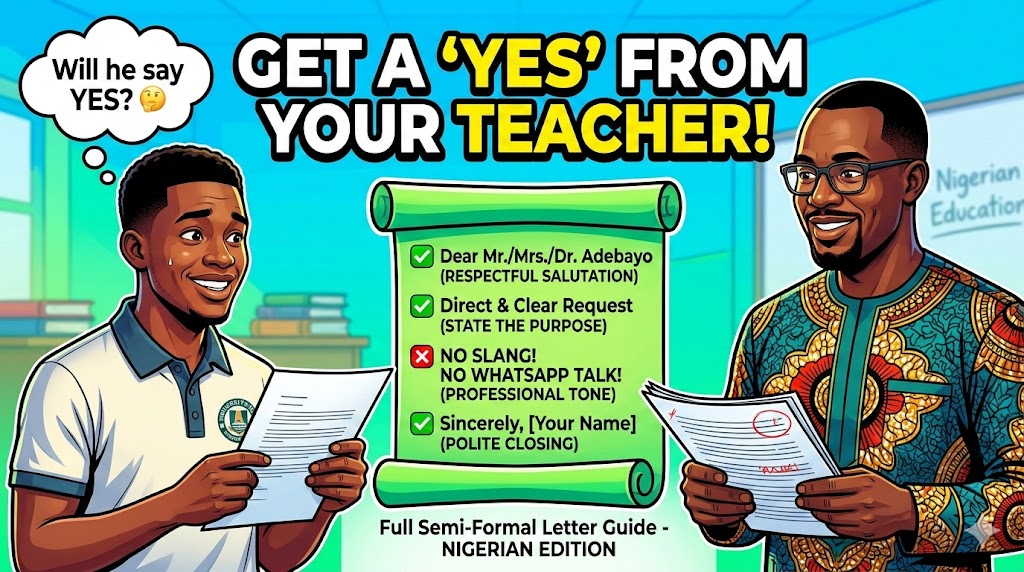
How to write a semi formal letter to your teacher in nigeria
Let’s be real. Many students completely miss the mark when communicating with their lecturers or secondary school teachers. They either sound like a 19th-century colonial clerk writing a petition, or they send messages that look like casual WhatsApp chats with a friend. Neither works.
Figuring out how to write a semi formal letter to your teacher in nigeria is a crucial survival skill in our educational system.
The truth is, your tone dictates how fast your problem gets solved. Teachers handle hundreds of students and massive administrative headaches. If your letter lacks basic respect or takes too long to make a point, it gets pushed aside.
Here is a quick breakdown of what you need to do:
-
Get your address and the date right.
-
Use the correct, respectful salutation.
-
Keep the opening direct and polite.
-
State the main reason for writing clearly.
-
Provide necessary context without over-explaining.
-
Close with an appropriate sign-off.

Steps on How to Write a Semi Formal Letter to Your Teacher in Nigeria
Let’s break down exactly how to structure your message without crossing the line into disrespect or sounding completely robotic.
1. Structure the Addresses and Date Properly
In Nigeria, structure still matters. If you are submitting a physical letter, put your address at the top right, the date directly below it, and the teacher’s designation on the left. If it’s an email, obviously skip the physical addresses. Email etiquette for students requires a clear, professional subject line. Don’t leave the subject blank or write “Hello sir.” Use something specific like “Request for Assignment Extension – [Your Name] – [Class/Matric Number]”.
2. Nail the Salutation
This is where many people fail. Nigerian teachers value respect. Do not use their first names. Stick to “Dear Mr. Adebayo,” “Dear Mrs. Okafor,” or “Dear Dr. Ibrahim.” Even if your school is quite modern, defaulting to standard titles shows you have home training. If you are sending a letter of apology to a teacher, starting with the right level of respect softens the blow before they even read the content.
3. Cut to the Chase
Forget the long greetings about how you hope the weather is treating them and their family. Go straight to the point, but do it politely. I am writing to inform you…” or “I am writing to request…” Teachers are busy marking scripts. They don’t have time for fluff. Keep your writing clear and concise. ### 4. Explain the Situation Practically Whether it’s an excuse duty letter because you were sick, or you are asking for clarity on a project, state the facts. “I was unable to attend the continuous assessment test on Tuesday due to a severe malaria bout.” Provide proof if necessary, like a clinic report. Don’t invent elaborate, dramatic stories. They have heard it all. When learning how to write a semi formal letter to your teacher in nigeria, remember that transparency beats storytelling every time. If you want to see how professionals structure clear requests, checking how to format formal business letters can actually help you understand the baseline before you tone it down for a semi-formal context.
5. Close with Respect
Your sign-off should strike the right balance. “Yours faithfully” is too rigid—save that for an official letter format addressed to the principal. “Cheers” is way too casual and generally considered disrespectful in the Nigerian educational system. Go for “Yours sincerely,” “Best regards,” or “Respectfully yours.” Then, put your full name and your class or matriculation number below it. This makes it easy for them to identify you immediately. You can read more on closing letters professionally to see acceptable global standards that adapt perfectly to the Nigerian setting.
Final Thoughts on Writing Your Teacher
Mastering how to write a semi formal letter to your teacher in nigeria simply boils down to respect and clarity.
-
Never use slang or textspeak (like ‘u’, ‘ur’, ‘lol’) in any correspondence with a teacher.
-
Proofread before sending. A letter filled with typos shows a serious lack of effort.
-
Match the medium. If it’s a quick update, an email is fine. If it’s a serious request or apology, a neatly handwritten or printed physical letter carries much more weight.
Frequently Asked Questions
Can I send a WhatsApp message instead of a letter?
Only if the teacher explicitly created a WhatsApp group for the class or gave you direct permission to message them. Even then, keep the polite tone intact and treat the message like a short semi-formal letter. Don’t send voice notes unless requested.
Do I need to include a title or subject heading?
For physical letters, a subject heading (e.g., “Request for Make-Up Test”) is highly recommended because it gives immediate context to a busy teacher. For emails, a subject line is absolutely mandatory.
What is the difference between formal and semi-formal in Nigeria?
A strictly formal letter to a principal requires a highly rigid structure (two addresses, “Dear Sir/Madam”, “Yours faithfully”). A semi-formal letter to a teacher you interact with daily allows for a slightly more conversational tone and “Yours sincerely,” but you must still maintain strict respect for their authority.