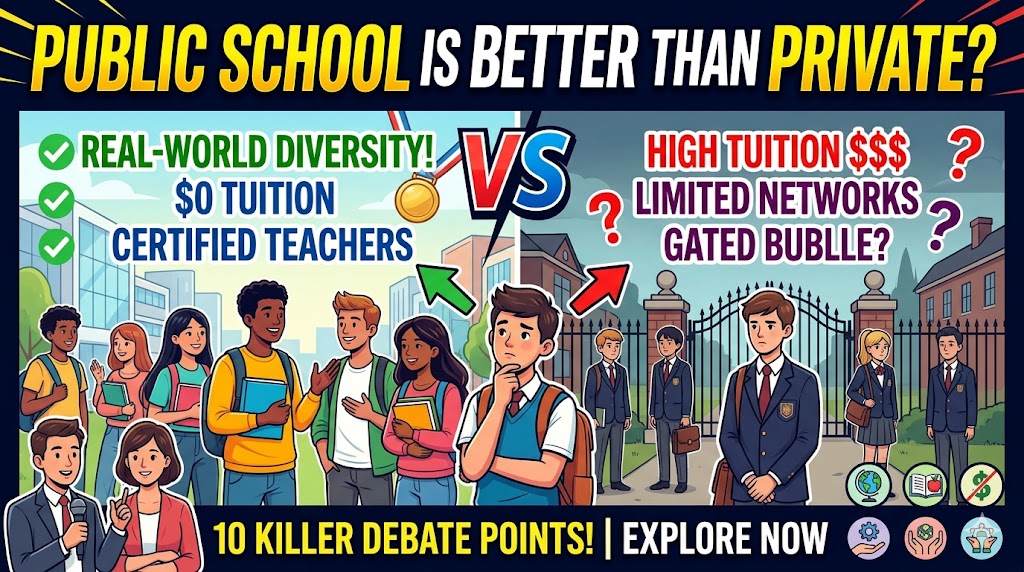
In this debate on public school is better than private school, the core argument isn’t just about money; it’s about the quality of the community and the depth of the experience. Public schools are designed to serve everyone, and that mission creates an environment that mirrors the real world better than any gated campus ever could. Let’s break down the most persuasive arguments for why public education remains the gold standard.
1. Real-World Diversity and Social Integration
Public schools are a melting pot of different cultures, economic backgrounds, and perspectives. In a private setting, students often live in a bubble, surrounded by people who think and act exactly like them. This lack of exposure can leave them unprepared for the diverse workforce they will enter as adults.
When children interact with peers from all walks of life, they build empathy and social intelligence. They learn how to navigate different viewpoints and collaborate with people who aren’t from their social circle. This is a vital life skill that a sheltered environment simply cannot replicate.
2. High Standards for Teacher Certification
One of the most overlooked facts in the debate on public school is better than private school is that public school teachers usually face stricter licensing requirements. In most states, public educators must have specific degrees and ongoing professional development to stay in the classroom.
Private schools, on the other hand, are often exempt from these state mandates. This means they can hire staff without traditional teaching credentials. While some private teachers are excellent, the standardized certification process in public districts ensures a baseline of pedagogical expertise that protects the quality of instruction.
3. Financial Freedom for Families
Education should be a right, not a luxury that leaves families drowning in debt. Public schools allow parents to redirect their hard-earned money toward other vital areas, like college savings, extracurricular passions, or family stability. The “free” price tag of a public education is a massive economic advantage.
Many private school families struggle to keep up with tuition, uniforms, and “hidden” fees. By choosing public, you are investing in your child’s future without sacrificing your family’s current financial health. Economic stability at home is often more impactful on a child’s success than the name on their high school diploma.
4. Superior Special Education and Support Services
By law, public schools must provide services for students with disabilities or learning differences. This includes speech therapy, occupational therapy, and individualized education plans. Private schools can often turn students away or simply fail to provide the necessary support because they aren’t bound by the same federal regulations.
If a child develops a learning hurdle, the public system is equipped with a network of specialists ready to help. This safety net ensures that no child is left behind regardless of their learning style or physical needs.
5. Better Access to Extracurricular Resources
Because public schools serve a larger population, they often have the tax-funded budget to support massive athletic programs, diverse clubs, and state-of-the-art facilities. Many smaller private schools lack the numbers to sustain a full orchestra, a high-tech robotics team, or a variety of varsity sports.
Public districts often pool resources to create specialized vocational programs and advanced placement courses that small academies can’t afford. This gives students the chance to explore their unique interests without being limited by a small school’s narrow curriculum.
6. Accountability to the Public
Public schools are answerable to the taxpayers and the government. If a school is underperforming, there are clear, public mechanisms for intervention and improvement. There is a transparent record of test scores, safety data, and budget allocations that anyone can look up.
Private schools operate behind closed doors. If something goes wrong—whether it’s a dip in academic quality or a safety issue—parents may not find out until it’s too late. Transparency and accountability are the hallmarks of a healthy educational system, and public schools provide both.
7. The Debate on Public School is Better Than Private School Regarding Community
Public schools serve as the heartbeat of a neighborhood. They are where neighbors meet, where local traditions are born, and where community pride is fostered. When a child attends a local school, their friends live down the street, not three towns away.
This proximity builds a stronger support network for both the child and the parents. In the broader debate on public school is better than private school, we have to recognize that the social fabric of a local community is much tighter when everyone is invested in the same local institution.
8. Preparation for Democratic Citizenship
The primary goal of public education is to create informed, capable citizens. Public schools teach students how to function within a democratic society by exposing them to different viewpoints and civic responsibilities. They are the training ground for the leaders of tomorrow.
Private schools can sometimes prioritize a specific religious or philosophical agenda over a broad, balanced education. Public schools focus on critical thinking and civic duty, ensuring that students are ready to contribute to the common good of the nation.
9. Reliability of Transportation and Logistics
Logistics might sound boring, but they matter for a child’s well-being. Public schools provide busing, which ensures that every student has a reliable way to get to class. This removes a massive layer of stress for working parents who can’t spend hours every day in a carpool lane.
In many cases, the time saved on a commute to a distant private school is time a child could spend sleeping, studying, or playing. A local school simplifies life, allowing the family to focus on what really matters: learning and growth.
10. The Power of Inclusive Excellence
When a school is open to everyone, it creates a culture of inclusion. Students learn that talent and intelligence aren’t reserved for the wealthy. They see that hard work and brilliance come from every corner of society. This fosters a sense of fairness and meritocracy.
Private schools can inadvertently teach kids that they are “separate” or “better” because of their enrollment. Public schools ground students in the reality that true excellence is inclusive. This mindset is exactly what modern employers look for in innovative, forward-thinking leaders.
Conclusion
The debate on public school is better than private school usually comes down to what we value as a society. While private schools offer exclusivity, public schools offer the world. They provide qualified teachers, diverse social environments, and legal protections that private institutions simply cannot guarantee. By choosing public education, we aren’t just saving money; we are choosing to raise children who are resilient, empathetic, and ready for the complexities of the 21st century.