
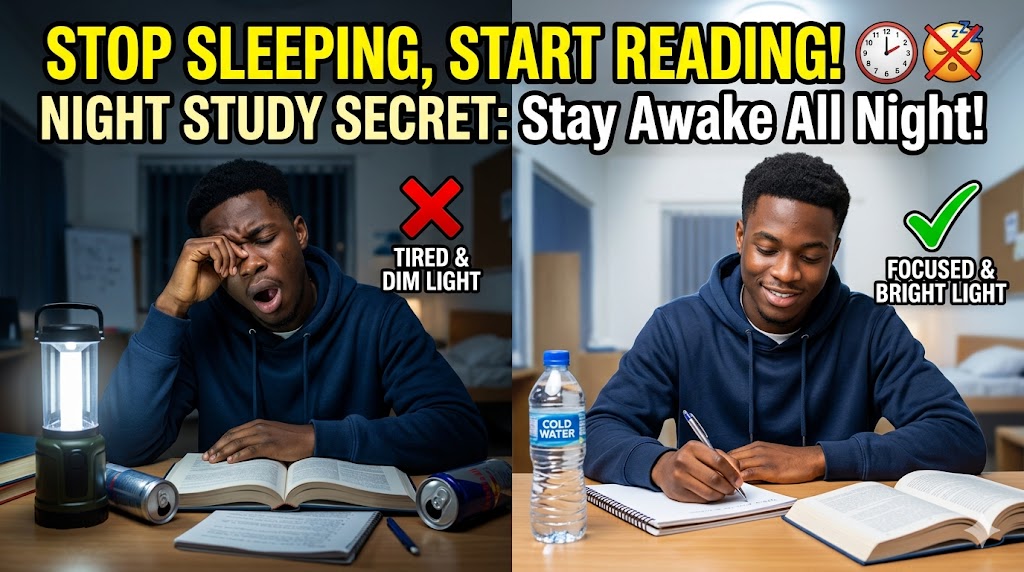
If you are constantly asking, How to study late at night without feeling sleepy?, you need to drop the myths. Relying on six cups of cheap coffee or high-sugar energy drinks will only give you a brief spike before a massive crash.
Here’s the truth. Staying awake to read isn’t about fighting your body. It is about outsmarting it.
Mastering How to Study Late at Night Without Feeling Sleepy?
1. Fix Your Lighting
Nigerians love to read with one dim rechargeable lamp pointing strictly at the book to save battery. Bad idea. When your environment is dark, your brain naturally produces melatonin. That is the sleep hormone. Your body literally thinks it is bedtime. If you want to stay alert, you need to flood your space with bright light. Turn on the main room light. The brighter your environment, the more you trick your circadian rhythm into believing it is still daytime, keeping your brain fully active. It helps to understand how light directly affects your sleep patterns so you stop sabotaging your own study sessions.
2. Ditch the Bed
This is a classic mistake. You arrange your pillows perfectly, lay back with your textbook, and tell yourself you are just getting comfortable. Ten minutes later, you are gone. Your bed is designed for sleeping, not studying. Your brain associates that specific environment with rest. To fix this, get out of the bedroom if you can. If you can’t, sit upright at a desk or a stiff dining chair. The mild discomfort of sitting upright forces your body to maintain a baseline level of alertness.
3. Eat Light, Drink Water
Think about it. You just finished a heavy plate of eba or pounded yam at 9 PM. What do you expect to happen? Heavy carbohydrate meals cause a spike in blood sugar followed by a sharp drop, which brings on extreme fatigue. This is basic biology. If you are trying to figure out how to study late at night without feeling sleepy?, your diet is your first line of defense. Swap heavy dinners for lighter meals or snacks like fruits and nuts. Keep a bottle of cold water next to you. Dehydration makes you sluggish, and taking sips of cold water provides a tiny shock to your system that keeps you awake. Medical experts consistently highlight how food intake heavily impacts your nighttime alertness.
4. Use Active Learning Techniques
Staring blankly at a page of text is the fastest way to fall asleep. Passive reading is boring. When your brain is bored, it shuts down. You need to engage in active learning techniques. Don’t just read. Write short summaries. Solve past questions. Explain the concept out loud to an imaginary audience in your room. Pacing around while reciting key formulas is highly effective. When your physical body and your vocal cords are engaged, sleep stays far away.
5. The Pre-Night Nap
You cannot run on zero sleep all day and expect to magically turn into a reading machine at midnight. It does not work. Many people fail to realize that the secret to night reading actually starts in the afternoon. Take a 30 to 45-minute power nap during the day. It clears the fatigue from your daily activities and gives your brain a fresh slate. Do not oversleep, or you will wake up groggy. Just a quick reset.
Final Thoughts on How to Study Late at Night Without Feeling Sleepy?
-
Sit upright at a proper table. Never study on your bed unless you plan to sleep immediately.
-
Keep the lights bright. Avoid dim lamps that trigger sleep hormones.
-
Engage with the material. Write, solve, and speak out loud to force your brain to stay active.
-
Hydrate constantly. Drink cold water instead of relying solely on heavy caffeine or sugar.
Frequently Asked Questions
Are energy drinks effective for studying late at night?
Not really. While they give you a quick burst of energy, they lead to a severe sugar crash a few hours later. If you must use caffeine, stick to a moderate cup of black coffee or tea, but proper hydration and good lighting are much safer, longer-lasting strategies.
What is the best time to take a break when reading at night?
Use the Pomodoro technique. Study for 50 minutes and take a 10-minute break. During that break, stand up, stretch, or walk around the room. Do not use the break to lie down or scroll endlessly on social media.
Why do I keep struggling with how to study late at night without feeling sleepy?
You are likely fighting massive sleep deprivation. If you haven’t slept properly in three days, no technique will work. Your body needs rest. Sometimes, the most productive thing you can do is sleep for four hours, wake up early at 4 AM, and study then. Quality sleep always beats forced, exhausted reading.