
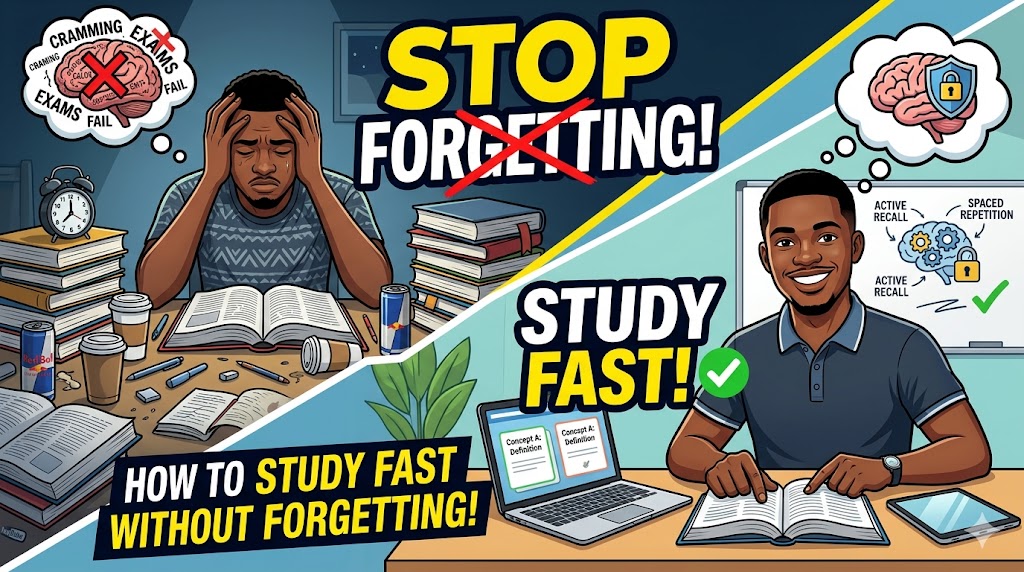
Every exam season in Nigeria, you see the same panic. Students load up on coffee, chew bitter kola, and keep their eyes open with pure willpower just to cover a massive syllabus in one week.
They spend 12 straight hours “jacking” in the library. Then, they sit for the exam, look at question number one, and their brain goes completely blank. It’s painful.
Let’s be real. Reading until your eyes hurt is not a strategy. The truth is, most Nigerian students are taught to memorize, not to learn.
If you are trying to figure out how to study fast without forgetting, you have to throw away the outdated cramming methods. Cramming only tricks your brain into feeling productive for a few hours. To actually retain information and perform well, you need a working system.

Proven Strategies on How to Study Fast Without Forgetting
When people ask me how to study fast without forgetting, I always tell them that reading hard is completely different from reading smart. You need to switch from passive absorption to active engagement.
1. Ditch Passive Reading for Active Recall
Here’s the thing about just opening a textbook and highlighting sentences: it’s lazy. Your brain feels comfortable because the words are right there. But the moment you close the book, the illusion shatters. To fix this, you need active recall methods. After reading a page, close the book and force yourself to write down or say out loud what you just read.
This curve visually explains human memory. It shows exactly how fast information leaks from your brain if you don’t actively try to retrieve it. Testing yourself is how you learn, not just re-reading.
2. Space Out Your Reading Sessions
We love the “fire brigade” approach in this country. Waiting until two weeks before a major exam to open a textbook is a recipe for failure. You cannot force a semester’s worth of knowledge into your head in 48 hours. Instead, use spaced repetition. Read a topic today, test yourself on it tomorrow, then three days later, and then a week later. This signals to your brain that the information is actually important to keep. You can use flashcard apps to automate this or read more about how spaced repetition algorithms work to build your own schedule. Building long-term memory retention requires intervals, not all-nighters. ### 3. Use the Feynman Technique If you can’t explain a concept to a JSS1 student in plain English, you don’t actually understand it. You’ve just memorized the textbook’s big grammar. The Feynman Technique is brutally simple. Write down the concept on a blank sheet of paper. Explain it out loud as if you are teaching someone with zero background knowledge. When you start stammering or using confusing jargon, you have found a gap in your knowledge. Go back to the material, fix that gap, and try again. This method forces deep cognitive understanding and is a core pillar of how to study fast without forgetting.
4. Work With Your Brain, Not Against It
Studying for six hours straight is a lie. Your focus naturally drops after about 45 minutes to an hour. Continuing to stare at a book after your brain has shut down is just punishing yourself. Break your study time into structured blocks.
Work intensely for 25 to 50 minutes, then take a strict 5 to 10-minute break to walk around, stretch, or drink water. Stay away from social media during these short breaks. You can check out reliable time management frameworks for studying to see why structured intervals actually speed up the learning process. Your brain processes and stores information during the breaks, not just when you are reading. Mastering how to study fast without forgetting is heavily dependent on letting your brain rest.
Final Thoughts on Maximizing Study Efficiency
-
Stop highlighting and start testing. Active recall beats passive reading every single time.
-
Space it out. Don’t wait for the exam timetable to drop before you start reading. Small daily chunks are better than massive weekend binges.
-
Teach it. If you can explain complex topics simply, you will never forget them.
-
Take real breaks. You are a human being, not a generator. Rest is required to convert short-term data into permanent knowledge.
Frequently Asked Questions
Why do I forget everything I read during exams?
You forget because you relied on short-term memory through cramming and passive reading. Under exam stress, short-term memory fails. You need to use active recall and self-testing to move that information into your long-term memory before the exam day.
How many hours a day should a student study?
Quality beats quantity. Four hours of highly focused, uninterrupted study using spaced repetition is vastly superior to twelve hours of distracted, exhausted reading. Most top students cap their intense studying at 4 to 6 hours daily, broken into manageable blocks.
Is it better to study at night or early morning?
This depends entirely on your personal circadian rhythm. Some people are highly alert at 4:00 AM, while others focus best at 10:00 PM. Find the time when your energy levels are naturally highest and block that out for your most difficult subjects. Sleep deprivation, however, will destroy your memory regardless of when you study.