
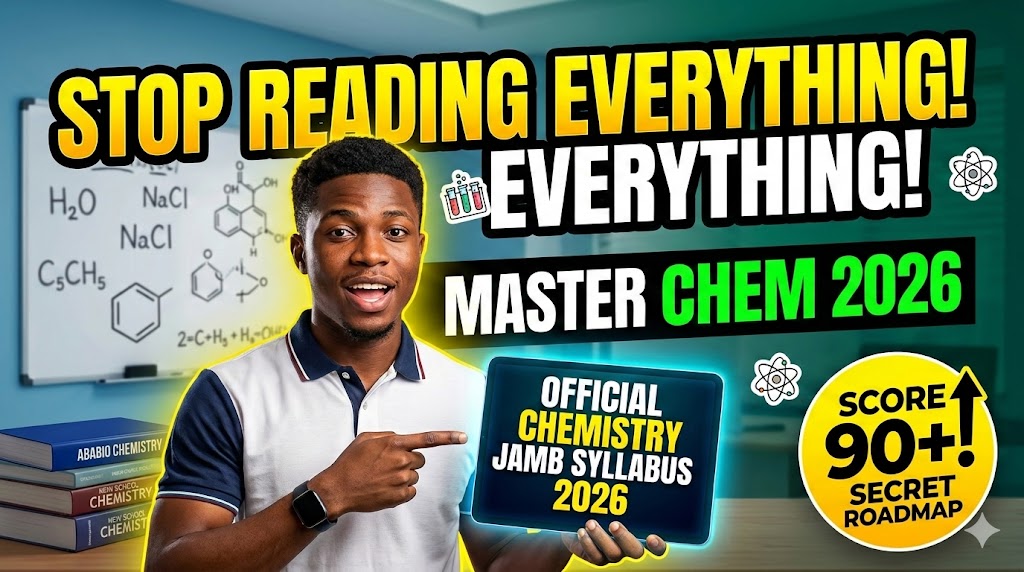
What is the chemistry jamb syllabus 2026?
If you think reading your entire SS1 to SS3 textbook cover-to-cover is the secret to scoring 90+ in Chemistry, you have already started on the wrong foot.
Let’s be real: JAMB is not a test of how much you can cram; it is a test of how well you can follow instructions. Every year, thousands of Nigerian students fail because they are busy studying “everything” instead of studying the chemistry jamb syllabus 2026.
The truth is, the examiners have a boundary, and if you cross it, you are just wasting precious brain cells that should be used for Physics or Biology. You need to stop “reading hard” and start reading smart by following the actual road map provided by the board.
Quick List of Chemistry JAMB Syllabus 2026 Topics
-
Separation of mixtures and purification of chemical substances
-
Chemical combination
-
Kinetic theory of matter and Gas Laws
-
Atomic structure and bonding
-
Air
-
Water
-
Solubility
-
Environmental pollution
-
Acids, bases, and salts
-
Oxidation and reduction
-
Electrolysis
-
Energy changes
-
Chemical equilibrium
-
Rates of chemical reactions
-
Non-metals and their compounds
-
Metals and their compounds
-
Organic chemistry
-
Chemistry and Industry
Mastering the Chemistry JAMB Syllabus 2026 for High Scores
The chemistry jamb syllabus 2026 is not just a list of topics; it is a cheat code. If you look closely, you will see that some topics carry more weight than others. You cannot spend three weeks studying “Air” and then spend two days on Organic Chemistry. That is academic suicide. Let’s break down the core areas where JAMB usually sets their traps and how you can escape them.
1. Separation of Mixtures and Chemical Combination
Many students overlook this because it feels like “Junior Secondary School” work. That is a massive mistake. JAMB loves asking about the purity of chemical substances and specific separation techniques like fractional distillation or chromatography. You need to know which method is best for what mixture. Under chemical combination, you must master the laws of chemical combination and basic stoichiometry. If you cannot calculate the number of moles or the empirical formula, you are already leaving marks on the table.
2. Atomic Structure and Bonding
This is the foundation of everything. If you don’t understand electronic configuration, you will struggle with every other topic. You need to know how to use the periodic table to predict the properties of elements. Here is the thing: JAMB won’t just ask you the definition of an electrovalent bond. They will give you two elements with their atomic numbers and ask you what kind of bond they will form. You should be comfortable with hybridization and the shapes of molecules. You can check out Khan Academy’s chemistry section to visualize these molecular shapes better.
3. Acids, Bases, and Salts
This is a “hot zone” in every UTME examination. You must understand titration calculations, pH scales, and the properties of different types of salts. Don’t just memorize definitions. Know why some salts undergo hydrolysis and others don’t. The difference between a strong acid and a concentrated acid is a favorite trick question for JAMB examiners. Make sure you understand the concept of buffer solutions and indicators as well.
4. Oxidation, Reduction, and Electrolysis
Redox reactions are the nightmare of many Nigerian students, but they don’t have to be. The secret is to master oxidation numbers first. Once you can calculate those, identifying the oxidizing and reducing agents becomes easy. For electrolysis, focus on Faraday’s laws. You will almost certainly see a calculation involving the mass of a substance deposited at an electrode. It is a standard routine. Practice these calculations until you can do them in your sleep.
5. Organic Chemistry: The Big Boss
If you avoid Organic Chemistry, you can forget about a high score. It usually takes up a significant chunk of the chemistry jamb syllabus 2026. You must understand homologous series, isomerism, and the nomenclature (naming) of organic compounds. Whether it is alkanes, alkanols, or alkanoic acids, you need to know their functional groups and key reactions. Don’t just read about them; draw the structures. The truth is, once you understand the pattern of how carbon behaves, this section becomes the easiest place to pick up points.
6. Energy Changes and Equilibrium
You need to understand enthalpy changes and whether a reaction is exothermic or endothermic. JAMB often asks about Le Chatelier’s principle. If you change the pressure or temperature of a system at equilibrium, what happens? This is purely logic, not cramming. If you get the logic, you get the mark. Also, keep an eye on the rate of chemical reactions and the factors that affect them, like catalysts and surface area.
7. Metals and Non-Metals
This part is quite broad, but you can narrow it down. Focus on the extraction of metals like aluminum, iron, and tin. You don’t need to know every single detail, but you must know the ores and the basic processes (like the Haber process for Nitrogen or the Contact process for Sulphur). These industrial applications are very common in the CBT practice sessions you will face. For more details on official guidelines, you should always keep an eye on the JAMB official facility for updates on the syllabus or brochure.
Final Thoughts on the 2026 Chemistry Syllabus
-
Focus on understanding concepts rather than memorizing long notes; JAMB tests application, not just recall.
-
Use past questions religiously alongside the syllabus to see how these topics are framed in the actual exam.
-
Master your calculations in stoichiometry, gas laws, and electrolysis, as these are “sure banker” questions.
-
Start with the difficult topics like Organic Chemistry and Redox reactions while your brain is still fresh and you have time to practice.
Frequently Asked Questions
Is the Chemistry syllabus for 2026 different from previous years?
The core topics in the chemistry jamb syllabus 2026 remain largely the same as previous years. However, the emphasis on certain sub-topics can shift, and new recommended textbooks might be added. It is always best to use the most recent version to ensure you are not studying obsolete material.
Which textbook is best for JAMB Chemistry?
While many use “New School Chemistry” (Ababio), it is often more detailed than what you actually need for JAMB. It is a great reference, but you should also use the JAMB-recommended textbooks listed at the end of the official syllabus to ensure you are aligned with the board’s expectations.
How do I handle Chemistry calculations without a calculator?
JAMB provides a basic on-screen calculator, but it is very limited. The best strategy is to learn how to simplify numbers and work with scientific notation. Most JAMB calculations are designed to be solved using simple division and multiplication if you set up your equations correctly.