
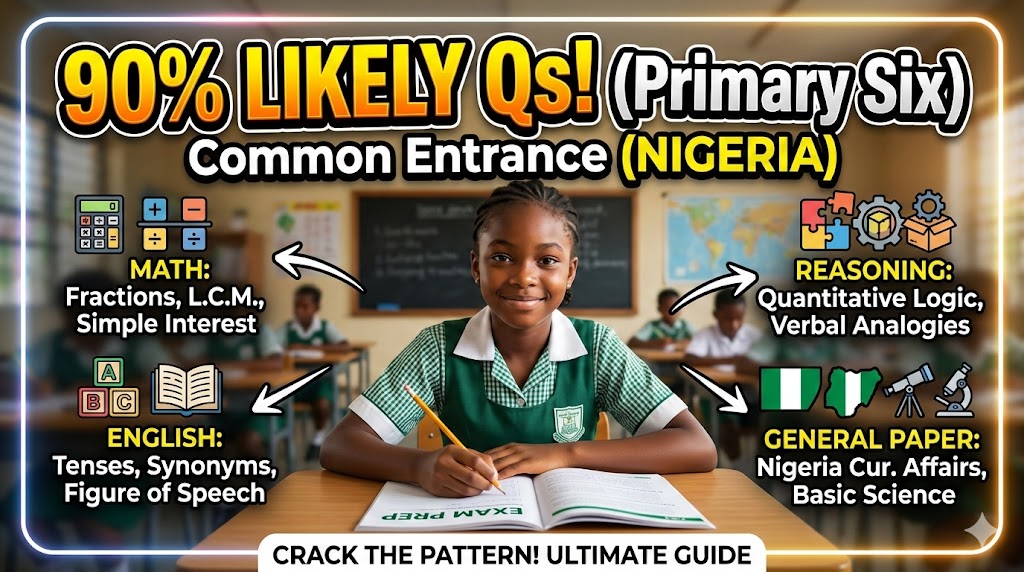
most repeated common entrance questions for primary six
The truth is that most parents in Nigeria are playing a guessing game with their child’s future. You spend money on expensive coaching and “special centers,” but your child is still struggling with the same patterns.
Let’s be real: examiners are not reinventing the wheel every year. They have a bank of concepts they recycle because those concepts test the core foundations of a primary six pupil.
If you are looking for the most repeated common entrance questions for primary six, you need to stop looking for “leaked papers” and start looking at recurring themes. Most pupils fail not because they are not brilliant, but because they are surprised by the format of the exam.
-
LCM and HCF of two or three numbers.
-
Conversion of fractions to percentages and decimals.
-
Word problems involving simple interest.
-
Calculation of area and perimeter of plane shapes.
-
Basic algebraic expressions and substitution.
-
Identification of parts of speech (Nouns, Pronouns, Verbs).
-
Synonyms and Antonyms of everyday words.
-
Proper use of “Since” and “For” in tenses.
-
Alphabetical ordering and dictionary usage.
-
Analogies (e.g., Hand is to Glove as Foot is to…).
-
Number series and pattern completion.
-
Decoding and encoding simple word ciphers.
-
Current affairs (President, Governors, and Symbols).
-
Basic science (Types of rocks, human organs, and planets).
-
Ratio and proportion in sharing money or items.
-
Identification of figures of speech like Similes and Metaphors.
-
Spelling of commonly confused words (e.g., Accommodation, Maintenance).
-
Understanding of “The Highest” and “The Lowest” in data sets (Mode/Median).
-
Social studies (The arms of government in Nigeria).
-
Quantitative reasoning boxes and triangles.
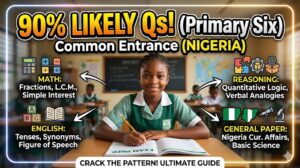
Mastery of Common Entrance Questions for Primary Six
The Nigerian secondary school admission process is a filter, not just a test. Whether your child is sitting for the National Common Entrance Examination (NCEE) or private school entrance exams, the examiners want to see speed and accuracy. Many students spend too much time on one difficult math question and lose marks on ten easy English ones. You must train them to recognize these common entrance questions for primary six the moment they see them.
1. Mathematics: The Battle of Fractions and Percentages
Year after year, the examiners bring back questions involving the conversion of fractions. A typical question might ask a student to convert 3/5 to a percentage or a decimal. It sounds simple, but under pressure, children mix it up. You should also watch out for word problems where a “man spends 1/4 of his salary on food and 1/3 on rent.” These are standard mathematics curriculum requirements in Nigeria. The trick here isn’t just knowing how to divide; it’s knowing how to find the Lowest Common Multiple (LCM) to resolve the denominators quickly.
2. English Language: Synonyms, Antonyms, and Register
In the English paper, the “Lexis and Structure” section carries the most weight. They don’t usually use “big grammar.” Instead, they test words that primary six pupils should know but often misspell or misuse. Expect questions on the meaning of underlined words in a sentence. Another recurring decimal is the use of “Appropriate Prepositions.” For instance, does a person “congratulate you for your success” or “congratulate you on your success”? (Hint: It’s “on”). Understanding these nuances is what separates those who pass from those who top the list.
3. Quantitative Reasoning: Decoding the Patterns
This is where most Nigerian students lose their “cool.” Quantitative reasoning isn’t exactly math; it’s logic. The common entrance questions for primary six in this category usually involve shapes with numbers at the corners. The student must find the relationship between the numbers to find the missing one. If they can’t figure out the “sample” in the first 30 seconds, they should move on. It’s usually a mix of square roots, basic multiplication, or simple addition hidden in a geometric shape.
4. Verbal Reasoning: Analogies and Alphabetical Coding
Verbal reasoning tests a child’s vocabulary and their ability to think laterally. You will almost always see questions like: “Light is to Dark as Wealthy is to…” (Answer: Poor). There’s also the alphabetical coding where “CAT” is written as “DBU,” and the child must figure out what “DOG” would be. This requires a sharp eye for letter-shifting patterns. If your child isn’t practicing with past entrance examination papers, they will be too slow on the exam day.
5. General Paper: The Nigerian Reality and Basic Science
The General Paper is a mix of Social Studies, Basic Science, and Vocational Studies. In the 2026 context, don’t be surprised to see questions about the current structure of the Nigerian government or the names of key leaders. In Science, focus on the “Human Body” (Digestive and Circulatory systems) and “Matter.” They love asking about the different states of matter or the names of the planets in the solar system. It’s broad, but the questions are usually surface-level.
6. Quantitative Boxes and Number Series
You will always find those “complete the series” questions. For example: 2, 4, 8, 16,…. The answer is 32 because the numbers are doubling. Sometimes the pattern is more complex, like 1, 4, 9, 16,… (which are square numbers). These logic-based questions appear every single year without fail. If a student understands the logic of the first five, they can solve the next fifty.
Winning Strategy for Entrance Exams
Here is the bitter truth: brilliance does not guarantee admission into the top-tier Unity Schools or elite private colleges in Nigeria. Strategy does.
-
Practice with a timer: Don’t just give your child past questions; give them a stopwatch. Speed is the biggest enemy in Nigerian exams.
-
Master the “Sample” first: In reasoning sections, if they don’t understand the sample, they shouldn’t touch the questions. The sample is the key.
-
Focus on the high-mark areas: English comprehension and Math word problems usually carry more weight. Don’t let them rush these.
-
Eliminate the impossible: Teach them how to look at the four options (A, B, C, D) and immediately cross out the two that make no sense. It increases their chances of guessing correctly if they get stuck.
Frequently Asked Questions
What are the most important subjects for Common Entrance?
The core subjects are Mathematics, English Language, Quantitative Reasoning, Verbal Reasoning, and General Paper. While all are important, Math and English are usually the primary filters used by schools to determine a child’s academic standing.
How can I help my child prepare for Quantitative Reasoning?
The best way is through consistent exposure to different types of patterns. Quantitative reasoning isn’t taught like regular Math in many schools, so you need to get specialized workbooks that focus on number puzzles and logic boxes.
Are the common entrance questions the same for all schools?
No. The National Common Entrance Examination (NCEE) is for Federal Unity Schools. However, state governments and private schools like Loyola Jesuit or Atlantic Hall set their own exams, though they all follow the basic primary school curriculum patterns mentioned above.