
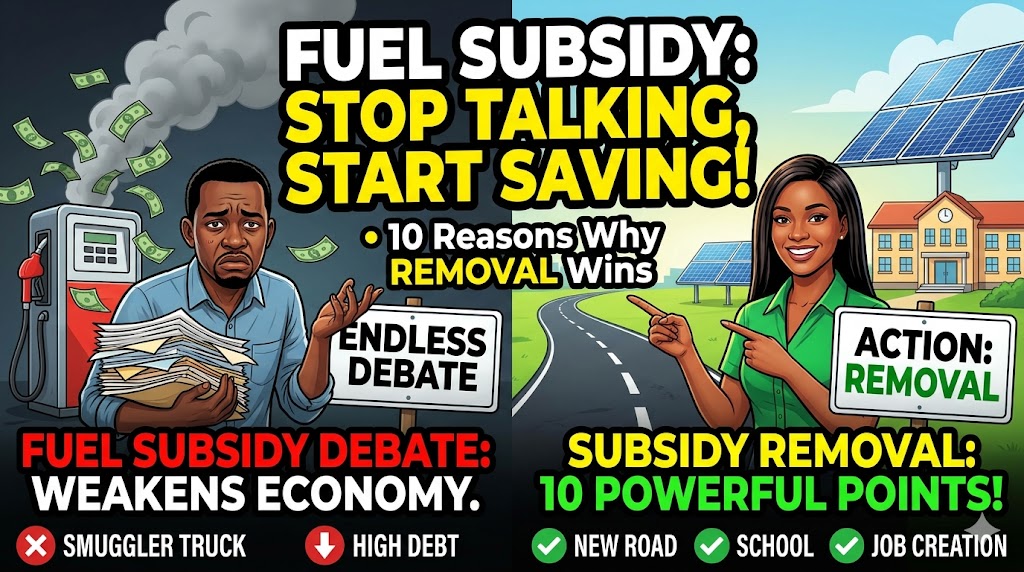
Why Fuel Everyone loves cheap fuel. But what is the real cost of that cheap fuel at the pump? For years, governments across the globe have bled billions to keep petroleum prices artificially low. This popular political move comes at a massive cost, quietly draining funds meant for schools, hospitals, and basic infrastructures
This brings us to a hard truth. Arguing that fuel subsidy removal is better than fuel subsidy debate is not about punishing the masses. It is about saving the future. Subsidies create an illusion of wealth while secretly hollowing out the economy from the inside.
By ripping off the band-aid, we can finally stop funding a broken, unsustainable system. We can start building an economy that actually works. We need to move past endless arguments and focus on actual economic recovery. Here are 10 reasons why taking decisive action outshines endless arguing.
1. Redirecting Funds to Real Development
The math is simple. When governments spend half their national revenue subsidizing imported petroleum, there is nothing left. The money meant to pay teachers, build roads, or upgrade power grids goes up in smoke at the gas station.
We cannot build a modern nation on cheap fuel alone. Real development requires hard cash. Removing the subsidy instantly frees up billions in the national budget.
Instead of burning money on consumption, the government can finally invest in capital projects. Better roads reduce vehicle wear and tear, and functional hospitals save lives. The long-term return on infrastructure far outweighs the short-term thrill of cheap petrol.
2. Killing the Black Market and Smuggling
Subsidies are a smuggler’s best friend. When a country artificially lowers its fuel prices, it creates a massive price gap with neighboring countries. Middlemen buy the cheap fuel, drive it across the border, and sell it at market value for massive profits.
This means the government is essentially subsidizing the economies of other nations. We are paying for criminals to get rich. The system is rigged to favor cartels and smugglers who exploit the price difference.
Removing the subsidy destroys this illegal black market overnight. When prices reflect actual market value, there is zero profit left in smuggling. The supply stays within the country, and the government stops losing money to shadow economies. Check out how international monitors track the impact of energy subsidies on corruption to see how deeply these policies breed illicit trade.
3. Attracting Private Investment
Nobody wants to build a business in a rigged market. For decades, investors have avoided building local refineries because government-controlled prices make it impossible to turn a profit.
Why spend billions building a state-of-the-art refinery if the law forces you to sell your product below cost? This is why many oil-producing nations still rely entirely on imported fuel. It is an embarrassing paradox.
A free, deregulated market invites serious investors. Once the government steps out of price-fixing, private companies will rush in to build refineries and storage facilities. Competition drives efficiency. More refineries mean more local jobs, better technology, and eventual price stability based on true supply and demand.
4. Subsidies Disproportionately Benefit the Rich
There is a massive misconception that cheap fuel helps the poor the most. The reality is totally different. The core reason why fuel subsidy removal is better than fuel subsidy debate regarding equality is that the rich consume way more fuel.
A low-income worker might take a shared bus to work. Meanwhile, a wealthy business owner is filling up three SUVs and running massive diesel generators at home. The government is essentially handing out the biggest financial rewards to the people who need them the least.
This is terrible economic policy. Broad subsidies worsen income inequality. Removing the subsidy stops this unfair transfer of wealth from the national treasury to the upper class.
5. Reducing the Crippling National Debt
Governments do not have magic money trees. When oil prices spike globally, the cost of keeping local fuel cheap skyrockets. To cover this massive gap, governments borrow heavily.
They take out domestic and foreign loans just to pay the subsidy bill. This traps the country in a vicious cycle of debt. We are literally borrowing money from future generations just to burn cheap gas today. You can see this pattern clearly in data highlighting the relationship between government debt and energy subsidies.
By ending the subsidy, the government drastically cuts its borrowing needs. Lower national debt means a healthier economy. It leads to lower inflation, better credit ratings, and a more stable financial future for everyone.
6. Strengthening the Local Currency
Importing refined petroleum requires hard currency, usually US dollars. When a country relies on imported, subsidized fuel, the central bank is constantly draining its foreign exchange reserves to pay for it.
This constant demand for dollars puts massive pressure on the local currency. The local money loses value, making everything else—from food to medicine—more expensive for the average citizen.
Deregulating the downstream sector eases this currency pressure. It reduces the frantic daily demand for foreign exchange by the government. A stable currency lowers the cost of living across the board, providing relief that goes way beyond the gas pump.
7. Environmental Benefits and Green Energy Transition
Cheap fossil fuels are terrible for the environment. When petrol is artificially cheap, no one cares about energy efficiency. People drive more, buy gas-guzzling vehicles, and ignore renewable energy options.
This is another area where fuel subsidy removal is better than fuel subsidy debate because we desperately need to modernize our energy grid. High fuel prices force innovation. They push businesses and individuals to look for cheaper, cleaner alternatives.
Suddenly, solar panels, electric vehicles, and efficient public transport become highly attractive investments. Removing the financial crutch of cheap oil is the fastest way to kickstart a green energy revolution and reduce our carbon footprint. Comprehensive data on global fossil fuel subsidies proves that pricing carbon correctly is the first step to environmental recovery.
8. Creating Targeted Social Safety Nets
The main argument for keeping subsidies is that the poor will suffer without them. But giving everyone cheap gas is the laziest way to help the vulnerable.
Instead of a blanket subsidy, the government can use a fraction of those saved billions to create highly targeted welfare programs. We can fund direct cash transfers, free healthcare for minors, or subsidized public transportation.
Targeted welfare helps the right people. It ensures that the nation’s wealth actually reaches the poorest households directly, rather than trickling down through a corrupt fuel supply chain.
9. Promoting a Competitive Downstream Sector
Price controls breed laziness and poor service. When the government dictates the exact price of a liter of fuel, gas stations have no reason to compete.
Customers deal with long queues, poor customer service, and rigged fuel pumps. The historical inefficiency of the oil sector proves that fuel subsidy removal is better than fuel subsidy debate if we want a healthy, customer-focused market.
In a deregulated market, gas stations have to fight for your money. They compete on price, fuel quality, and extra services. Market competition naturally forces bad businesses out and rewards efficiency, ultimately giving the consumer a much better experience.
10. Long-Term Survival Over Short-Term Relief
Subsidies are a painkiller, not a cure. They temporarily numb the pain of a struggling economy while allowing the underlying disease to get much worse.
We cannot debate our way out of a mathematical impossibility. Running a country on borrowed money to fund a consumption habit always ends in an economic crash.
Taking the bold step to remove the subsidy is painful at first. Prices go up, and inflation bites. But this is the necessary surgery required to fix the system. Enduring a tough transition phase sets the foundation for lasting, sustainable economic growth.
Conclusion
We cannot keep doing the same things and expecting a different outcome. The emotional attachment to cheap fuel has held economies hostage for far too long, breeding corruption, stifling infrastructure, and ballooning national debt.
While the debates and town halls drag on, the financial bleed continues. Ultimately, fuel subsidy removal is better than fuel subsidy debate because action builds nations, while endless deliberation just delays the inevitable. It is time to face reality, embrace a free market, and finally invest our resources into the actual growth and development of our people.