
What is the literature syllabus for jamb 2026?
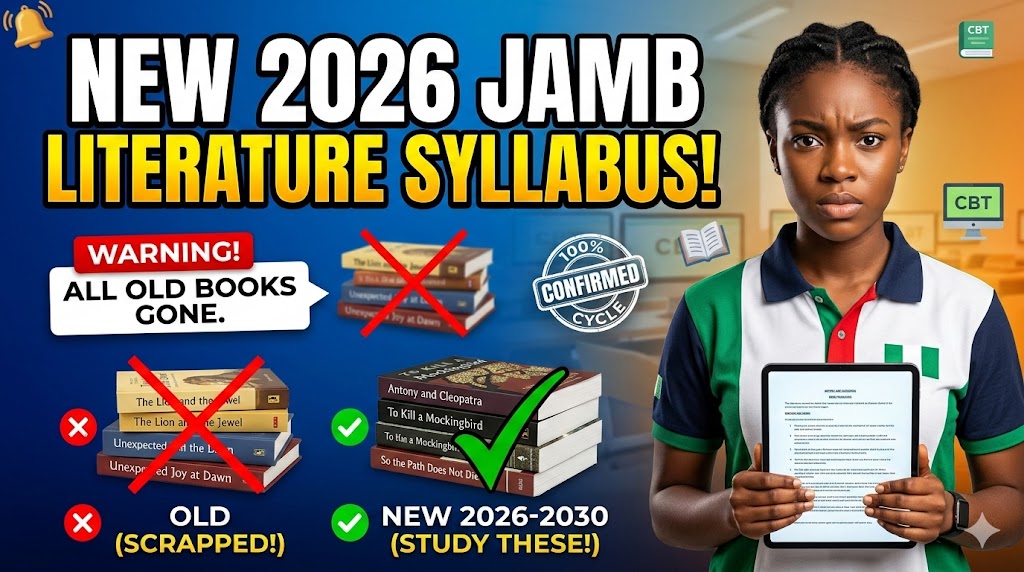
Listen up. If you are banking on reading last year’s Unexpected Joy at Dawn or cramming your elder brother’s worn-out notes on The Lion and the Jewel, you are setting yourself up for a massive disaster.
Let that sink in. The rules have completely changed. The literature syllabus for jamb 2026 is out, and it officially kicks off a brand new 2026–2030 cycle. Every single novel, play, and poem you thought you knew has been wiped off the board.
We are looking at a completely fresh slate. It’s time to wake up and smell the coffee because relying on outdated JAMB past questions for your set texts will only give you options that simply do not exist anymore.
The literature syllabus for jamb 2026
-
General Literary Terms and Principles
-
Shakespearean Drama: Antony and Cleopatra
-
African Drama: The Marriage of Anansewa, Once Upon an Elephant
-
Non-African Drama: An Inspector Calls, A Man for All Seasons
-
African Prose: So the Path Does Not Die, Redemption Road
-
Non-African Prose: To Kill a Mockingbird, Path of Lucas: The Journey He Endured
-
African Poetry: 6 selected poems including Once Upon a Time and Night
-
Non-African Poetry: 6 selected poems including She Walks in Beauty and Still I Rise
-
Literary Appreciation (Unseen Prose and Poetry)
The Brutally Honest Breakdown of the literature syllabus for jamb 2026
The truth is, many candidates treat Literature like a hobby. They just read the books for fun, laugh at the characters, and then walk into the CBT center expecting to score 80. It doesn’t work that way. JAMB does not test how much you enjoyed the story. They test your critical analysis. They want to see if you actually understand literary devices, central themes, and character foils.
1. The Drama Section: Shakespeare and Real-Life Palava
You cannot escape Uncle William. For 2026, the prescribed Shakespearean text is Antony and Cleopatra. The English used here is heavy, so do not wait until a week before the exam to start decoding it. For African Drama, you are expected to consume Efua Sutherland’s The Marriage of Anansewa and Bosede Ademilua-Afolayan’s Once Upon an Elephant. Read the actual texts, not just those cheap summary pamphlets sold in traffic. You need to thoroughly understand the socio-political context of these plays. Then, for Non-African Drama, you have An Inspector Calls by J.B. Priestley and A Man for All Seasons by Robert Bolt. JAMB will test you on specific acts and scenes. Know your lines.
2. Prose: Your Reading Stamina Will Be Tested
Prose usually carries heavy marks. For African Prose, Pede Hollist’s So the Path Does Not Die and Elma Shaw’s Redemption Road are your new companions. These books tackle heavy real-world issues. For Non-African Prose, Harper Lee’s classic To Kill a Mockingbird is on the list alongside Susanne Bellefeuille’s Path of Lucas: The Journey He Endured. Here is the thing. Do not just watch the Hollywood movie adaptations and think you are prepared. Movies change plots for entertainment. JAMB examiners know the exact differences and will set trap questions based on them. Read the books to grab the correct narrative techniques and characterization.
3. Poetry: Where Most Candidates Fail
Omo, this is the zone where tears flow freely. Many students just skim through the poems, cram a few figures of speech, and pray for the best. The 2026 syllabus brings in 12 completely fresh poems. The African poetry list includes heavyweights like Gabriel Okara’s Once Upon a Time, Wole Soyinka’s Night, and Niyi Osundare’s Not My Business. For Non-African poetry, you are battling with Lord Byron’s She Walks in Beauty, Maya Angelou’s Still I Rise, and an excerpt from Geoffrey Chaucer’s The Nun’s Priest’s Tale. You must memorize the basic poetic devices, the mood, and the exact tone of every single stanza.
4. General Literary Principles & Unseen Texts
JAMB will always throw unseen passages and poems at you to test your raw intelligence. You cannot cram for this. You either know it or you don’t. You need to be able to identify an elegy, a satire, or a stream of consciousness from a random paragraph you have never seen before in your life. To stay sharp, crosscheck the official WAEC syllabus updates because JAMB borrows heavily from their general structure. Learn the raw definitions of literary terms before you enter that exam hall.
Final Thoughts on Conquering JAMB Literature
-
Buy the actual books: Stop managing 10-page summaries. Read the full texts so you can handle context-based questions confidently.
-
Study the authors’ backgrounds: Knowing the history of Elma Shaw or J.B. Priestley will seriously help you answer tricky questions about the setting of their works.
-
Master literary terms: Before you even open a novel, ensure you can define metonymy, synecdoche, and enjambment in your sleep.
-
Use past questions smartly: Only use past questions to test your knowledge on unseen passages and general principles. For the specific novels and poems, those old questions from 2024 are completely useless to you now.
Frequently Asked Questions
Has the JAMB literature syllabus changed for 2026?
Yes, absolutely. The 2026 exam starts a completely new five-year cycle (2026-2030) for both WAEC and JAMB. Every single novel, play, and poem from the old 2021-2025 cycle has been entirely replaced.
Which Shakespeare book is JAMB using for 2026?
Candidates will be tested on Antony and Cleopatra by William Shakespeare. Make sure you read a version with good modern English footnotes so you actually understand what is going on.
Can I just read the summaries of the JAMB literature books?
You can, but you will likely fail. JAMB sets highly specific context questions like “Who said this to whom and where?” Summaries skip these minor details. Read the full texts at least once before relying on any summary for revision.